|
|
| (16 intermediate revisions by 2 users not shown) |
| Line 62: |
Line 62: |
| | In cylindrical coordinates, <math>d^2r=rdrd\phi \quad</math>. Without loss of generality, we consider a harmonic solution with a particular frequency ω = kc. | | In cylindrical coordinates, <math>d^2r=rdrd\phi \quad</math>. Without loss of generality, we consider a harmonic solution with a particular frequency ω = kc. |
| | :<math>\dot{A}\left(\mathbf{r},t'-\frac{|\mathbf{r}-\mathbf{r}'|}{c}\right)=\dot{A}(\mathbf{r},0)e^{-ik(t'c-|\mathbf{r}-\mathbf{r}'|)}</math><br><br> | | :<math>\dot{A}\left(\mathbf{r},t'-\frac{|\mathbf{r}-\mathbf{r}'|}{c}\right)=\dot{A}(\mathbf{r},0)e^{-ik(t'c-|\mathbf{r}-\mathbf{r}'|)}</math><br><br> |
| − | :<math>A(r')=\frac{-ikz'A_0}{2\pi}\,e^{-i\omega t'} \int_{z=0} rdrd\phi\, \frac{e^{ik|\mathbf{r}-\mathbf{r}'|)}}{|\mathbf{r}-\mathbf{r}'|^2}</math> | + | :<math>A(r')=\frac{ikz'}{2\pi}\,e^{-i\omega t'} \int_{z=0} rdrd\phi\, \frac{e^{ik|\mathbf{r}-\mathbf{r}'|)}}{|\mathbf{r}-\mathbf{r}'|^2}A_0(\mathbf{r},0)</math> |
| | | | |
| | == Special Case == | | == Special Case == |
| | Picture an opaque screen with a circular aperture of radius a.<br><br> | | Picture an opaque screen with a circular aperture of radius a.<br><br> |
| − | Let<math>\mathcal{J}(r')=\int_0^a rdr\int_0^{2\pi} d\phi\, \frac{e^{ik|\mathbf{r}-\mathbf{r}'|}}{|\mathbf{r}-\mathbf{r}'|}</math><br><br> | + | Let<math>\mathcal{J}(r')=\int_0^a rdr\int_0^{2\pi} d\phi\, \frac{e^{ik|\mathbf{r}-\mathbf{r}'|}}{|\mathbf{r}-\mathbf{r}'|^2}</math><br><br> |
| | Then <math>A(r')=\frac{z'\dot{A_0}}{2\pi c}e^{-ikct'}\mathcal{J}(r')</math><br><br> | | Then <math>A(r')=\frac{z'\dot{A_0}}{2\pi c}e^{-ikct'}\mathcal{J}(r')</math><br><br> |
| | But <math>|\mathbf{r}-\mathbf{r}'|=\sqrt{(x-x')^2+(y-y')^2+z'^2}</math> | | But <math>|\mathbf{r}-\mathbf{r}'|=\sqrt{(x-x')^2+(y-y')^2+z'^2}</math> |
| | ::<math>=\sqrt{r^2+r'^2+2r\rho^2\cos\phi}</math><br> | | ::<math>=\sqrt{r^2+r'^2+2r\rho^2\cos\phi}</math><br> |
| − | ::<math>=r'-\frac{2r\rho'\cos\phi}{2r'}\frac{\rho'}{r'}\sin\theta'</math><br><br> | + | ::<math>=r'-\frac{2r\rho'\cos\phi}{2r'}, \frac{\rho'}{r'}=\sin{\theta}'</math><br><br> |
| − | so that <math>\frac{1}{|\mathbf{r}-\mathbf{r}'|^2} \approx \frac{1}{r'^2}\left(1+\frac{2r\sin\theta'\cos\phi}{r'}\right)</math> | + | so that <math>|\mathbf{r}-\mathbf{r}'|=r'-r\cos{\phi}\sin{\theta}'</math> and <math> \frac{1}{|\mathbf{r}-\mathbf{r}'|^2} \approx \frac{1}{r'^2}\left(1+\frac{2r\sin\theta'\cos\phi}{r'}\right)</math><br><br> |
| | + | In this particular case, we are dealing with far-field effects only, so <math>\frac{2r\sin\theta'\cos\phi}{r'}\rightarrow 0 </math> and <math>\frac{1}{|\mathbf{r}-\mathbf{r}'|^2} \approx \frac{1}{r'^2}</math><br><br> |
| | + | So, <math> \mathcal{J}(r')=\int_0^a rdr\int_0^{2\pi} d\phi\, \frac{e^{ik|\mathbf{r}-\mathbf{r}'|}}{|\mathbf{r}-\mathbf{r}'|}=\frac{e^{ikr'}}{r'^2}\int_0^a rdr\int_0^{2\pi} d\phi\, e^{-ikr\sin{\theta}'\cos{\phi}}</math><br><br> |
| | + | The integral <math>\int_0^{2\pi} d\phi\, e^{-ikr\sin{\theta}'\cos{\phi}}</math> is the integral representation of the zero order Bessel function of the first kind with <math> kr\sin{\theta}' \quad</math> as the argument. This gives us the equation:<br><br> |
| | + | :<math>\mathcal{J}(r')=\frac{e^{ikr'}}{r'^2}\int_0^a rdr 2\pi J_0(kr \sin{\theta}') </math><br><br> |
| | + | To simplify the math, we make use of the fact that we can represent this Bessel functions as the derivative of a Bessel function of a different order. In general, the formula to compute this derivative is <br><br> |
| | + | :<math>z^{v-k}J_{v-k}(z)=\left(\frac{1}{z}\frac{\part}{\part z}\right)^kz^vJ_v(z)</math><br><br> |
| | + | In this case, we take <math>v=k=1 \quad</math> and <math>z=kr\sin{\theta}' \quad</math>. So<br><br> |
| | + | :<math>J_0(kr\sin{\theta}')=\left(\frac{1}{kr\sin{\theta}'}\frac{\part}{\part (kr\sin{\theta}')}\right)(kr\sin{\theta}')J_1(kr\sin{\theta}')</math><br><br> |
| | + | This gives us the equation |
| | + | :<math>\mathcal{J}(r')=2\pi\frac{e^{ikr'}}{r'^2}\int_0^a rdr \left(\frac{1}{kr\sin{\theta}'}\frac{\part}{\part (kr\sin{\theta}')}\right)(kr\sin{\theta}')J_1(kr\sin{\theta}')</math><br><br> |
| | + | Let <math>x=kr\sin{\theta'} \quad </math> so that |
| | + | :<math>\mathcal{J}(r')=2\pi\frac{e^{ikr'}}{k^2\sin^2{\theta}'r'^2}\int_0^{ka\sin{\theta'}} dx \frac{d}{dx}xJ_1(x)</math> |
| | + | <math>\mathcal{J}(r')=2\pi\frac{e^{ikr'}}{k\sin{\theta}'r'^2}\left[aJ_1(ka\sin{\theta}')-0J_1(0k\sin{\theta}')\right]=2\pi\frac{e^{ikr'}}{k\sin{\theta}'r'^2}aJ_1(ka\sin{\theta}')</math><br><br> and <math>A(r')=\frac{z'\dot{A_0}}{2\pi c}e^{-i\omega t'} 2\pi\frac{e^{ikr'}}{k\sin{\theta}'r'^2}aJ_1(ka\sin{\theta}')=\frac{z'\dot{A_0}a}{c}\frac{e^{ikr'-i\omega t'}}{k\sin{\theta}'r'^2}J_1(ka\sin{\theta}')</math><br><br> |
| | + | To find the angle to the diffraction minimum, we must find the zeroes of this amplitude function. This will occur when <math>J_1(ka\sin{\theta}')=0 \quad</math><br><br> |
| | + | [[Image:Bessels_J0.svg|thumb|300px|right|Plot of Bessel function of the first kind, J<sub>α</sub>(x), for integer orders α=0,1,2.]] |
| | + | |
| | + | To the right is a graph of three Bessel functions of the first order, specifically <math> J_0(x), J_1(x), and J_2(x) \quad</math>. As it is shown, the first zero of <math>J_1(x) \quad</math> will <br> |
| | + | occur at <math>x=0 \quad</math>. This will correspond to the center of the pattern, at <math>\theta=0 \quad</math>. Here, we would expect a bright spot, so <math>A(r') \quad</math> should be positive and finite. At <math>\theta=0 \quad</math> the term <math>\frac{J_1(ka\sin{\theta}')}{\sin{\theta}'}</math> is positive and finite, so this expression gives the correct amplitude at <math>\theta=0 \quad</math>. The next zero of <math> J_1(x) \quad</math> corresponds to the first minumum of the diffraction pattern. In this case, this zero occurs at x=3.832. So, <math>ka\sin{\theta}'=3.832 \quad</math> . Since<math> k=\frac{2\pi}{\lambda}\quad</math> and <math> a=\frac{D}{2}\quad</math><br><br> |
| | + | |
| | + | <math>\frac{2\pi D\sin{\theta}'}{2\lambda}=3.832\rightarrow \sin{\theta}'= \frac{1.22\lambda}{D}</math> |
We start off with Maxwell's Equation in the Lorentz gauge:

where we use the metric signature (+,+,+,-) and


The gauge condition for the Lorentz gauge is

Introduce the Green's function at  from some impulse source at

and its Fourier transform


Translational symmetry implies

so that


where  . But
. But


Chose the "retarded" solution, such that the function is zero unless t>t'.


![{\displaystyle ={\frac {1}{(2\pi )^{2}}}{\frac {2}{|\mathbf {r} -\mathbf {r} '|}}{\frac {2\pi }{4}}\left[\delta (|\mathbf {r} -\mathbf {r} '|+c(t-t'))-\delta (|\mathbf {r} -\mathbf {r} '|-c(t-t'))\right]\Theta }](https://wikimedia.org/api/rest_v1/media/math/render/svg/48541628af99cf28e2d003864682e6565eaa5915)
But the term  so that

Now to get the  in the half-space with z>0 with the boundary condition
  at
at we take the difference:

Now use Green's theorem, with the generating function

![{\displaystyle \int \partial _{\mu }F_{\mu }d^{4}r=\int cdt\int d^{3}r[\partial _{\mu }A\partial ^{\mu }G+A\partial _{\mu }\partial ^{\mu }G_{1}-\partial _{\mu }G\partial ^{\mu }A-G_{1}\partial _{\mu }\partial ^{\mu }A]}](https://wikimedia.org/api/rest_v1/media/math/render/svg/c807a3acf6af188a25a7f51900bfbaecacfcd486)

 , let
, let 

Now invoke the divergence theorem on the half space  :
:
![{\displaystyle A(r')=-\int d^{2}r\int cdt\left[A(r){\frac {\partial }{\partial z}}G_{1}(r,r')-G_{1}(r,r'){\frac {\partial }{\partial z}}A(r)\right]}](https://wikimedia.org/api/rest_v1/media/math/render/svg/97ebc95c50a03464352e1b7ef7088bc2606a1587) , where the last term is zero by the condition of
, where the last term is zero by the condition of

To do the t integral, I need to bring out the z derivative. To do this, I first turn it into a z' derivative, using the relation

where 

∴ 
At  ,
, 
If is independent of position, as in a plane wave propagating along the z axis, then:

This gives us uniform translation of waves at velocity c. More generally:


In our case, we consider only those waves which drop off as  , so
, so

In cylindrical coordinates,  . Without loss of generality, we consider a harmonic solution with a particular frequency ω = kc.


Special Case
Picture an opaque screen with a circular aperture of radius a.
Let
Then 
But 


so that  and
and 
In this particular case, we are dealing with far-field effects only, so  and
and 
So, 
The integral  is the integral representation of the zero order Bessel function of the first kind with
  as the argument. This gives us the equation:

To simplify the math, we make use of the fact that we can represent this Bessel functions as the derivative of a Bessel function of a different order. In general, the formula to compute this derivative is

In this case, we take  and
and  . So
. So

This gives us the equation

Let  so that

![{\displaystyle {\mathcal {J}}(r')=2\pi {\frac {e^{ikr'}}{k\sin {\theta }'r'^{2}}}\left[aJ_{1}(ka\sin {\theta }')-0J_{1}(0k\sin {\theta }')\right]=2\pi {\frac {e^{ikr'}}{k\sin {\theta }'r'^{2}}}aJ_{1}(ka\sin {\theta }')}](https://wikimedia.org/api/rest_v1/media/math/render/svg/d2276a013157a101414698ee4e3397b2b8fef3ec)
and 
To find the angle to the diffraction minimum, we must find the zeroes of this amplitude function. This will occur when 
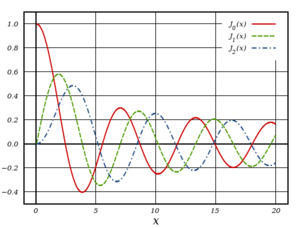
Plot of Bessel function of the first kind, J
α(x), for integer orders α=0,1,2.
To the right is a graph of three Bessel functions of the first order, specifically  . As it is shown, the first zero of
  will
will
occur at  . This will correspond to the center of the pattern, at
  . Here, we would expect a bright spot, so
  should be positive and finite. At the term
  is positive and finite, so this expression gives the correct amplitude at . The next zero of corresponds to the first minumum of the diffraction pattern. In this case, this zero occurs at x=3.832. So,
  . Since
 and
and 

