


 yield
yield
From the 3 data sample, events are selected by requiring
that there is no
data sample, events are selected by requiring
that there is no  in the event and that
 candidates from 2 pairs are constrained to
  of the mass (0.5
 0.6
0.6  ).
We do not require just the presence of the because production
is 50 times larger than . Without cutting on the ,
the signal competes with the combinatoric background.
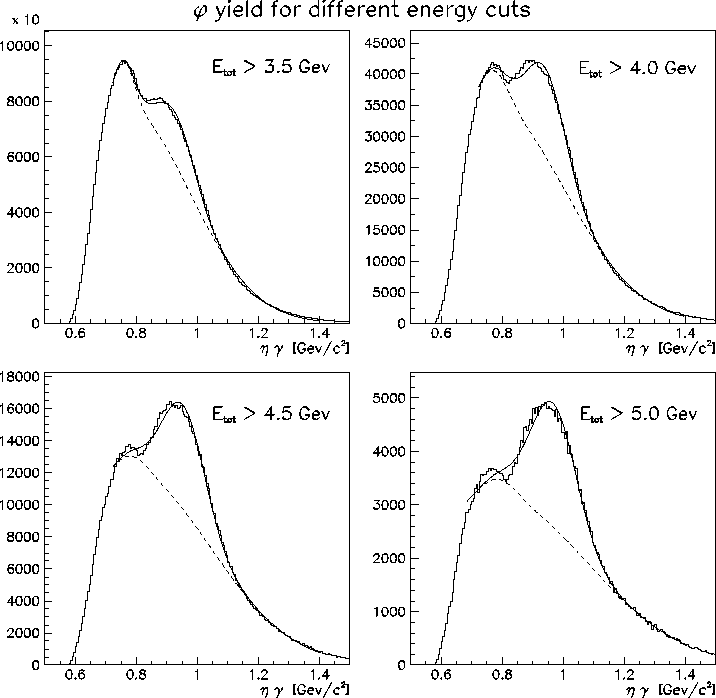
The invariant mass distribution of 3 is then formed for different
minimum total energy in the LGD. These distributions
for 4 different energy thresholds are shown in Fig. 1,
where one can see how the peak becomes more prominent when
the total energy threshold is increased.
).
We do not require just the presence of the because production
is 50 times larger than . Without cutting on the ,
the signal competes with the combinatoric background.
The invariant mass distribution of 3 is then formed for different
minimum total energy in the LGD. These distributions
for 4 different energy thresholds are shown in Fig. 1,
where one can see how the peak becomes more prominent when
the total energy threshold is increased.
The number of is found from the fit of these distributions to
3 Gaussians: one corresponding to the residual  peak,
one broad corresponding to the background (BG)
and the third one for the . To keep the number of parameters small,
the position of the background Gaussian is set to be equal to the position of
the peak, while the width of the BG is fixed to the width by
peak,
one broad corresponding to the background (BG)
and the third one for the . To keep the number of parameters small,
the position of the background Gaussian is set to be equal to the position of
the peak, while the width of the BG is fixed to the width by
 . In addition,
the width of is kept constant during fitting,
. In addition,
the width of is kept constant during fitting,
 .
Constants a and b are adjusted until good fits with reasonable
looking background is found. Obtained mass, width and yield for
different energy cuts are given in the Table 1.
.
Constants a and b are adjusted until good fits with reasonable
looking background is found. Obtained mass, width and yield for
different energy cuts are given in the Table 1.
![$E_{TOT} > [Gev] $](img19.png) |
![$M_{\phi} [Gev/c^2]$](img20.png) |
![$\sigma_{\phi} [Gev/c^2]$](img21.png) |
 |
||||
| 3.5 | 0.931 | 0.065 | 555513.0 | ||||
| 4.0 | 0.943 | 0.065 | 460076.0 | ||||
| 4.5 | 0.954 | 0.070 | 228128.0 | ||||
| 5.0 | 0.967 | 0.075 | 87140.4 |
 |