
Here p is the electron beam energy, k is the photon energy, and qmin is the momentum transfer to the recoil nucleus in the bremsstrahlung target when all scattering angles are 0. The normalization is arbitrary. Except for photon energies within 20% of the endpoint, last two terms are approximately constant across the photon beam, and the profile is given by the first term.
To describe the results of the beam scan, a two-dimensional image of above distribution was formed, and then integrated over the surface covered by the scintillator, assumed to by 2.54 x 2.54 cm2. The results for a 1.4GeV endpoint are shown below, overlayed with the data points. To convert to cm, angles were multiplied by 3960cm, which is the distance from the center of the radiator box at the tagger to the RadPhi target according to this drawing of Hall B. By comparing the solid and dotted curves, one can see how the bremsstrahlung cone shrinks somewhat as one approaches the endpoint. But the scintillator is sensitive mainly to the low-energy component of the photon beam, so the solid curve is the relevant one for this comparison.
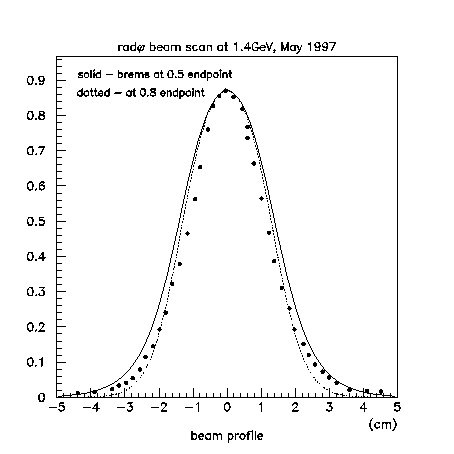
It appears that the calculation actually overestimates the size of the photon beam. The same exercise was carried out again at 4.0GeV endpoint, with the following results
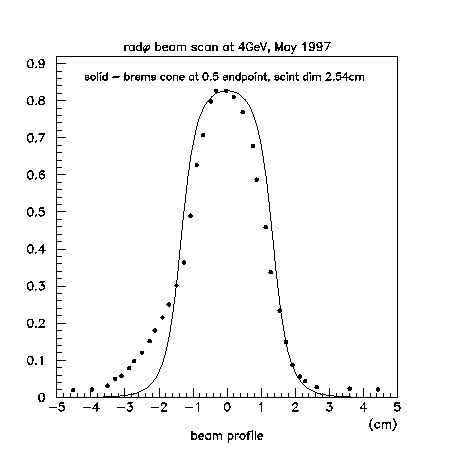
The original data for these figures were taken from the plots pointed to from the online web page. The measured points in these figures were shifted by +0.5cm to center them at zero; other than that there are no adjustable parameters in this comparison. Again at 4.0GeV the measurements are narrower than the calculation. But here the edges of the measured peak are narrower than the nominal size of the scintillator! I conclude that the dimensions of the scintillator must be smaller than 1in. I went down to the hall and discovered two things, that the scintillator is only (1.9 ± 0.1) cm wide, and it is oriented diagonally to the scan direction. The two figures above are repeated below with the curve recomputed under these new conditions.
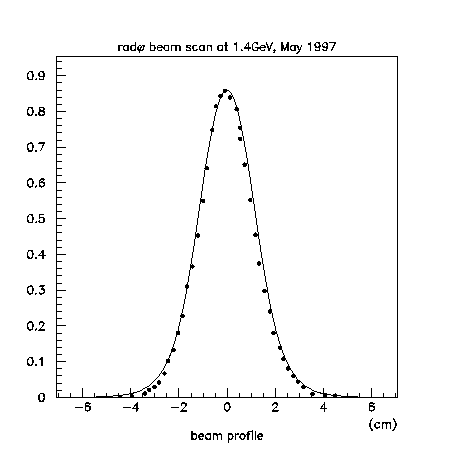
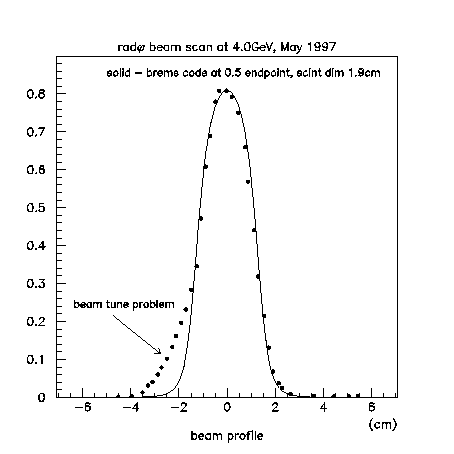
There are no adjustable parameters used in calculating the curve in these figures, except the height of the peak, which was scaled to match the data. An excellent description of the data is obtained, indicating that the beam spread due to the electron beam emittance is very small. The asymmetric shape of the peak in fig. 4 I take to be a consequence of an asymmetric electron beam spot at the tagger radiator. No collimator effects are evident in these data. In a final figure is shown the calculated photon beam profile as it would be seen by scanning with a 1mm x 1mm scintillator, to show the actual photon beam profile at our radiator.
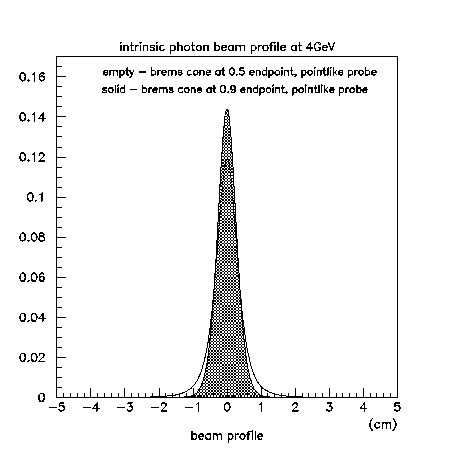
At energies very near the endpoint the spot is actually somewhat smaller. The shaded curve in fig. 5 is for photons at 90% endpoint, adjusted to have the same area as the solid curve, which applies to the bulk of the bremsstrahlung flux. The thought occurs to me that we might make use of this fact by making our target small and picking out only the central part of the beam. It is one of the disadvantages of the tagging technique that you cannot throw away any more than the fringes of the beam because collimation hurts the tagging efficiency, defined as the number of usable photons on target per count in the tagger. Keeping our tagging efficiency above 90% in the upper 20% of the bremsstrahlung spectrum fixes a minimum RadPhi target diameter of about 1cm at a 4.0GeV endpoint. Using a target much larger than that makes alignment less critical, but generates somewhat more untagged background in our detectors, although the difference is not huge.
Richard Jones,
RadPhi collaboration